Updated: 25 Apr 2026
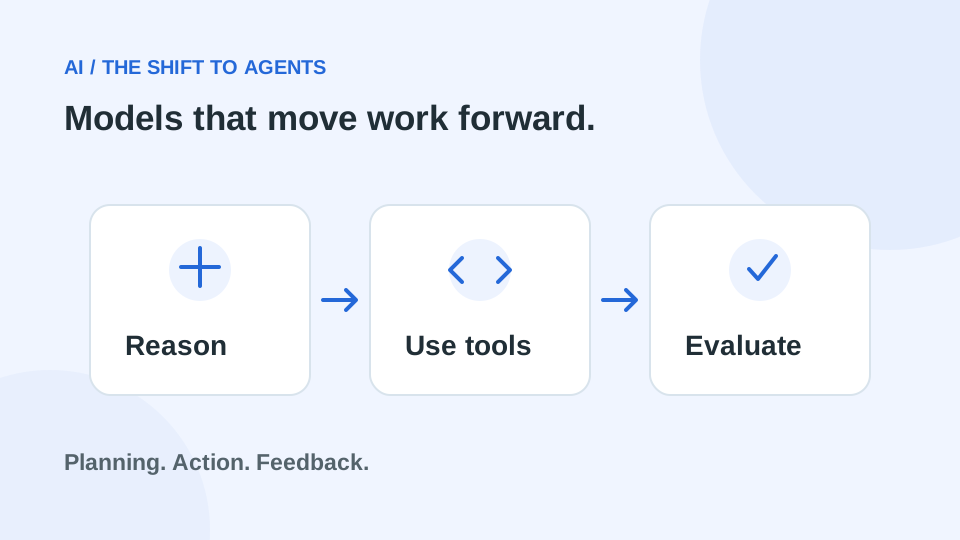
April 2026 AI news can be summarized in one sentence: the best models are no longer being sold as “chatbots,” they’re being sold as agents, systems that can plan, use tools, and keep working until the task is done.
For students, engineers, and QA professionals, this shift matters because it changes what skills are valuable: less “prompting,” more workflow design, evaluation, and automation guardrails.
TL;DR (key takeaways)
- Agent behavior (planning, tool use, iteration) is now a mainstream requirement.
- Governance (permissions, approvals, audit logs) is part of the product, not an add-on.
- Open models are catching up fast, especially for local and edge deployments.
1) GPT‑5.5: the “messy task” model
OpenAI’s GPT‑5.5 is positioned around end-to-end task completion: give it a multi-part goal, and it can break the work down, use tools, and keep going. This is especially relevant for coding and long-horizon work where you normally need multiple attempts.
How to evaluate it (practical): measure “time-to-done,” retries, and whether the model can validate its own output, not only whether it sounds correct.
2) Workspace agents: from prompts to reusable workflows
Workspace agents represent a big product shift: an organization can build a shared workflow once and reuse it across a team. The important part is not “AI can write,” it’s “AI can follow a process,” with controls like approvals and permissions.
3) Gemma 4: local-first AI is back
Gemma 4 highlights the growth of open models built for real deployment constraints. For many companies, “local” is not about cost, it’s about data control, latency, reliability, and being able to run offline when needed.
4) Gemini 3.1 Pro: reasoning for complex tasks
Gemini 3.1 Pro is marketed for tasks where a simple answer is not enough, which matches real engineering work: diagnosing failures, synthesizing information, planning under constraints, and producing structured outputs.
What this means for QA and automation
- AI-assisted testing works best when your assertions are deterministic and your test design is risk-based.
- Triage acceleration is often the fastest ROI: clustering failures, summarizing logs, correlating with recent changes.
- New QA skill: designing “agent-safe” workflows (approval gates, safe tool use, evaluation sets).
Learn this professionally (recommended)
MeetAhsan offers training aligned with these trends: